Autotherapy of your feet
- sportmassages

- Mar 21, 2020
- 6 min read
Today I would like to share with you useful information on the most common imbalances occurring during lower limb exercises. These aspects are often neglected, but all the more important in my opinion, given the proper functioning of not only the lower limb. The market supersaturation with misleading information is more than evident and then what is happening - most athletes / exercise people are primarily interested in performance and lifted pounds. Nobody is so much concerned with the settings of the body and legs. But the legs are the main point from which everything is based and which indicates the subsequent direction of training / performance and above all health - the most important thing we have.
I will start with a brief introduction and the basic functions of the foot, through which our foot is properly adjusted. If you walked, it does not work as it should, you will hardly put the rest of your body in an optimal position. A few lines will also be devoted to proprioception. I will also mention some common problems concerning the lower limbs (flat and swaying leg, valgus and knee varosity). In the practical part of the article, I will show specific corrective exercises that can be used both to correct problems and to improve the range of movement and safety of exercises.
Foot - everything starts here!
Take off your socks or shoes and see what your foot looks like. Focus on the following:
Where is the broadest foot - at the fingertips, when you try to spread them, or in another part?
How do you build your fingers, including your thumbs - are they loose or cramped?
Are the feet sore in some places?
Does your feet hurt when you stand for a long time or even exercise?
What about the heel and the Achilles tendon - are they evenly aligned in the leg axis, or turned in / out?
If you answered yes to the questions, you will learn why this may be the case and how to deal with asymmetry. I note that this is a basic and so-called "first aid" for pain, if your legs hurt for a long time, seek an expert.
.
Autotherapy used ball (tennis, golf, or foam)
A series of three simple exercises can be an effective solution to relieve your foot from pain. It really is a basic and quick pain relief. On the other hand, if you do these exercises more often, ideally every day, the difference will be striking. Above all, you will feel the foot lighter and "stretched" sideways. You can also activate and adjust it better during exercise, which is crucial.

Execution instructions: standing position, we try to distribute the weight of the body evenly on both feet, by gradual pressure massaging the foot in three positions.
Neglected imbalance in lower limbs
In this paragraph I will mention the most commonly occurring imbalance in the lower limbs, because I consider it important to talk about them. This is mainly because nobody solves these problems much. Except for physiopractitioners. These are mainly:
feet - flat foot, inward heel, high vault, this is also related to "X" legs
toes - thumb, hammered toes
ankles - immobility in the ankle joint and associated either increased or decreased dorsiflexion (ankle bending)
knees - valgus (inward), varosity (outward), recurrence (bending of the bone or joint backwards)
hip, pelvis - I mention the blockage of the SI articulation and the overall rigidity in this area

But what does it mean to us when we are faced with any of these problems? Problem next. As you could see, and I also mentioned it in the introduction to the article, the foot is the focal point of the whole body. Thus, from him, the "ills" will chain higher up the body. For the sake of consistency, let me give you one example of what can only happen because of an "innocent" looking deviation.
Suppose that a given "imaginary" individual suffers, for example, from a combination of limited dorsiflexion in the ankle joint, the inward heel of the calcaneus. A classic picture of most of my new arrivals as well as gym and fitness visitors. Often even children, which is striking. We also take into account that this "endowed" individual will normally exercise the lower limbs, such as squats with a large dumbbell on his back, lunges or deadlifts. Worse still, he doesn't even know about these asymmetries. Often it is only discovered when something "goes wrong". Also from this point of view, I perceive the importance of comprehensive diagnostics of the musculoskeletal system and screening of musculoskeletal patterns as what should be accomplished before one embarks on any sport.
Problems will most likely occur as follows: It is clear that the degree of ankle stiffness and calculus of the calcaneus will depend. First of all, the above knees are wrapped in the knee inwards, ie the legs into the "X". The hips will behave in an internal rotation. And for the sake of completeness, I will add possible knee problems in the form of knee joint pain. Lumbar spine overload is also likely.
The body set up just on paper looks menacing. It will appear much more spooky in the real picture. Think about what happens when we add weight or dynamics to the body. The risk of injury increases countless times! And I believe it can be really nasty things - lumbar spine injury, knee ejection and more, even just microtrauma of tissue, which will eventually result in injury in the future.

Solutions and strategies to put everything in order
I think that this example was more than transparent, and now it is up to you to correct these imbalances using a few basic corrective exercises. These will be broken down by segment. The order of the exercises will be governed by the successive leg segments. For each part, I will give you one exercise to work to remove constraints. Exercises should always be included before the training, as warming up.
The foot - exercises are listed above. For completeness I will add that the foot will benefit from care in the form of mobilization and flexibility. The necessary mobility will allow us to perform better and consequently stabilization and motor control. Focus on the shoes you are training in - often because of that they were in poor condition.
Ankles - need to be mobile, but often the opposite. Do you support your heels while squatting? Loosen the ankles and you no longer need to support them.

Execution instructions: in each position we try to maximize the range of movement in the ankle. There should be no twisting and stretching of the limbs in the hips.
Knee - often unstable or sore. Really. Today, knees are a hot topic in many sports. Their instability in combination with chained problems from their feet and ankles will not add to their health. We will focus on their stability and proper functioning. Together with other correctly prepared segments, their condition will improve. However, it really depends on the degree of wear and the condition diagnosed by the doctor. Be careful therefore.

Execution instructions: we try to execute the movement to the extreme range from side to side as in the picture. However, beware of the danger in the form of "jumping" knees. We are gradually extending the scope. It is a preventive and strengthening exercise for lateral stability of the knees (ligaments).
Muscles of the back of the thighs - I allow a small insertion because I consider it important. The muscles of the back of the thighs are also a risk component of the back chain . We need to work on their strength, but also on flexibility.
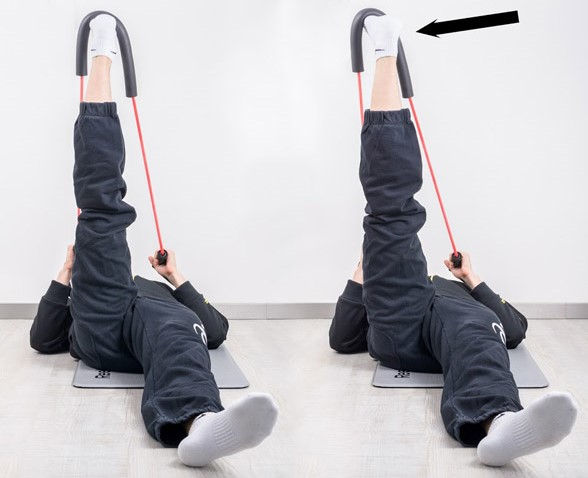
Execution instructions: in the lying position on the ground we pay attention to the maximum possible extension of the raised limb. The limb lying on the ground should not rise, but also be stretched. If the lying limb is lifted, we will shorten the range of motion of the extended limb.
Hip, buttocks - topic on separate article. Due to the "sedentary period" their area is in a deplorable state not only in people with sedentary jobs, but I observe it also in regular exercise. This is one of the key and particularly important areas. Without functional buttocks and mobile hips, movement will never be 100% - rather more risky.

Execution instructions: we try to execute the movement in a neutral spine setting, ie. the spine must not "bend" at any moment of movement. If this happens, we stop the movement and end in that position. The head looks slightly ahead - not all the way down or to the ceiling.
In conclusion, just a few words on the whole article. Don't be lazy and try practicing these exercises for some time. You will surely find out that there will be something to it. And your body will be better prepared to perform the performance you want. Of course, there will be less risk of injury and greater range of movement - better work and muscle involvement.


Comments